
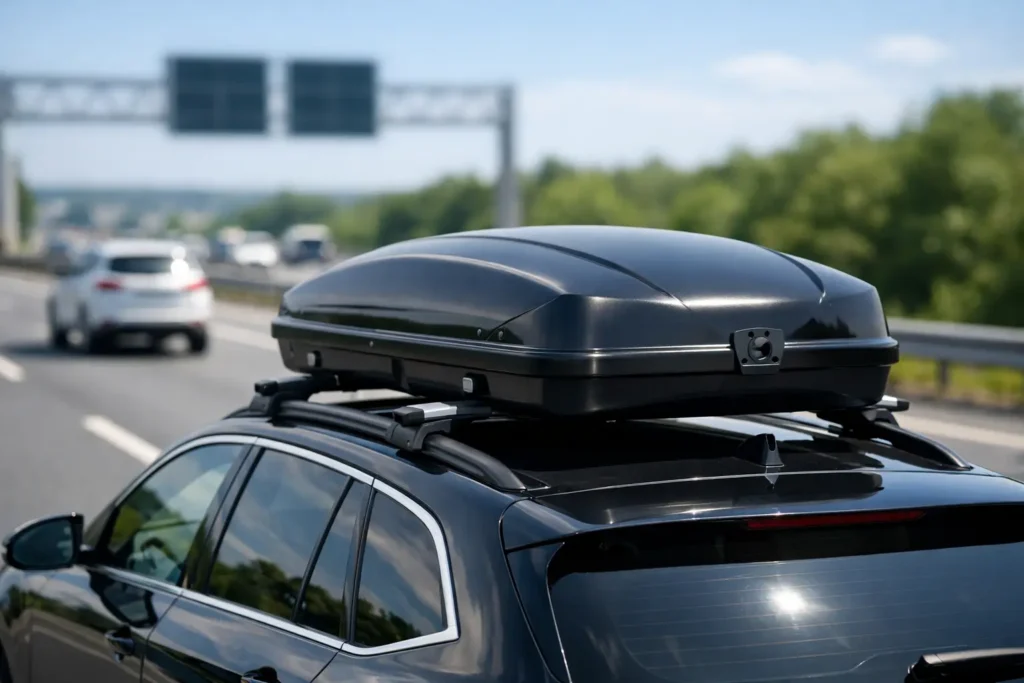
You usually notice a roof box problem at 70 mph, not on the driveway. It starts with extra wind noise, a slight rattle, or that nagging thought that the load above your head might not be as settled as it should be. If you want a secure roof box for motorway travel, the real difference is not just the box itself. It is the fit, the weight balance, the locking points, and whether it has been installed properly for your car.
For families heading off on vacation, couples packing for a long weekend, or anyone trying to free up trunk space for a dog, stroller, or camping gear, roof boxes make life easier. But motorway driving adds a different level of demand. Higher speeds, crosswinds, lane changes, and long hours on the road all put pressure on the setup. That is why security is about more than a key turning in a lock.
What makes a secure roof box for motorway travel?
A secure roof box for motorway travel starts with compatibility. The roof bars need to match the vehicle, the box needs to fit the bars correctly, and the mounting system needs to clamp firmly without movement. A good-quality roof box from a trusted European manufacturer will usually have strong locking systems and tested fittings, but even the best box can become a problem if it is fitted carelessly.
This is where many first-time users get caught out. They assume any roof box will fit any car, or that a quick DIY install is close enough. In reality, small fitting mistakes can show up quickly once you are on a faster road. If the bars are set at the wrong spacing, if the clamps are not tightened evenly, or if the box sits too far forward or back, the drive can become noisy, awkward, and less safe than it should be.
A secure setup should feel stable and predictable. The box should sit centered, the lid should close cleanly, and the locks should engage without forcing them. You should not be guessing whether it is attached properly.
Security is not just about theft
When people hear the word secure, they often think about locking the box when the car is parked. That matters, especially at service stations and hotel lots, but motorway security is just as much about load retention and stability.
A locked lid does not automatically mean a secure load. Items inside the box need to be packed sensibly so they do not shift heavily during braking or cornering. The total weight must stay within both the roof box limit and the car roof limit. Those two figures are not always the same, and the lower one is the one that matters.
There is also the issue of balance. Heavier items should go in the middle of the box, spread evenly from left to right. Soft bags work better than hard suitcases in many cases because they are easier to position without stressing the lid or internal space. If everything is shoved to one end, the car can feel less settled, especially in wind.
Why professional fitting makes such a difference
For occasional users, professional fitting is one of the simplest ways to remove stress before a trip. It saves time, but more importantly, it gives you confidence that the bars and box have been matched and installed correctly.
That matters even more for motorway driving, where small errors become obvious fast. A poorly aligned box can create more drag and more noise. An incorrectly fitted roof bar system can affect stability. If you are traveling with children, pets, or a fully loaded car, the last thing you need is uncertainty hanging over the trip.
Professional fitting also helps with practical details people often miss. Can the tailgate open fully? Is the box positioned to avoid interfering with the antenna? Is the load within limits for that specific vehicle? Those are not complicated questions, but they are easy to overlook when you are packing the night before departure.
For many drivers, renting rather than buying makes even more sense here. If you only need the extra space for vacations, camping trips, or a seasonal getaway, hiring a quality system that is fitted for you can cost far less than buying one, and you avoid finding somewhere to store it the rest of the year.
How to load a roof box for a safer motorway drive
The best roof box in the world cannot fix poor packing. How you load it has a direct effect on safety, comfort, and fuel use.
Keep the heaviest permitted items low and centered within the box. Avoid packing loose objects that can slide around. Use internal straps if the box has them, and do not overfill the lid area just because there is still space. If you have to force the lid shut, it is too full.
It is also worth thinking about what belongs in the roof box and what does not. Bulky but lighter items are usually the best fit – things like clothing bags, sleeping bags, folded camping gear, or extra family luggage. Very heavy gear is often better kept inside the car, where it has less effect on handling.
There is a trade-off here. People often choose a large box because they want maximum storage, but bigger is not always better if it tempts you to load too much or changes the feel of the car more than necessary. The right size is the one that gives you enough room without pushing your vehicle beyond comfortable limits.
A few motorway habits matter too
Even with a properly installed and well-packed box, driving style should adjust slightly. A car with a roof box is carrying weight higher up, and that changes how it feels on the road. It may respond differently in strong side winds, during sudden lane changes, or when passing large trucks.
That does not mean motorway driving becomes difficult. It just means being sensible. Leave a bit more stopping distance. Take corners and ramps more smoothly. Be aware of height restrictions at parking garages, drive-thrus, and hotel entrances. And after the first few miles, it is never a bad idea to stop safely and check that everything still feels secure.
Wind noise is also normal to a point. A roof box will usually add some sound at speed, and fuel economy may drop a little as well. That is part of the trade-off for gaining valuable cargo space. What you do not want is sudden banging, whistling that seems excessive, or movement you can see in the mirrors. Those are signs to stop and check the setup.
Choosing the right box for your trip
Not every journey needs the same roof box. A couple heading away for a weekend might need a slimmer option that keeps handling light and leaves room for bikes or other gear. A family of five going on a week-long vacation may need more volume, but still with a focus on sensible loading rather than simply filling every inch.
The best choice depends on your car, your passengers, and what you are carrying. If you drive a smaller hatchback or crossover, proportions matter. A box that overwhelms the roofline can be less practical than a slightly smaller one fitted properly. If you have a larger SUV or wagon, you may have more flexibility, but the same rules still apply around weight and balance.
This is where a specialist service is useful. Instead of trying to work out every detail yourself, you can get a setup chosen for the trip you are actually making. That is often the difference between a roof box that feels like a smart travel upgrade and one that feels like extra hassle.
At West Midlands Roof Box Hire, that practical side is exactly the point. People want more space for the journey without paying hundreds to buy equipment they may only use once or twice a year. A properly fitted, quality roof box gives you the benefit without the storage problem, guesswork, or wasted time.
Common mistakes that make a roof box less secure
Most motorway issues come down to a few avoidable mistakes. Using the wrong bars, ignoring weight limits, packing too heavily at one end, or assuming a lock means the job is done are all common examples. Another is rushing. Roof boxes are simple when fitted and loaded properly, but they are not something to throw on the car five minutes before leaving.
It also helps to think ahead about the full trip, not just departure day. If you plan to stop overnight, can you access what you need without unpacking everything? If the weather turns windy or wet, will the load still be protected and balanced? A secure setup is one that stays practical throughout the journey, not just at the start.
A roof box should make travel easier, not give you one more thing to worry about. When the fit is right, the load is sensible, and the installation has been handled professionally, motorway miles feel straightforward. You get the extra room, the cabin stays more comfortable, and the trip starts the way it should – with less squeezing, less stress, and more confidence before you even leave the driveway.