
October half-term is a fantastic opportunity to get away with the family before winter arrives.
Whether you’re heading to Wales, Center Parcs, the Lake District, a holiday park or even driving across to Europe, an autumn break can be just what everyone needs after the first few weeks back at school.
There’s just one problem.
Packing for an October holiday can be considerably more difficult than packing for summer.
In August, you can throw a few T-shirts, shorts and swimming clothes into a suitcase and you’re halfway there.
October requires a little more thought.
Coats, waterproofs, walking boots, jumpers and unpredictable British weather all mean more luggage.
At West Midlands Roof Box Hire, we’ve put together a practical guide to packing for your October half-term getaway, including ways to make better use of the space in your car.
Start with the Weather Forecast – But Don’t Trust It Completely!
Checking the weather forecast before you travel is an obvious starting point.
Unfortunately, anyone who has holidayed in Britain knows that the weather doesn’t always follow the script.
You might leave Birmingham in glorious sunshine and arrive in Wales to discover horizontal rain.
Two days later, you could be sitting outside a pub wondering why you packed three waterproof coats.
The solution is layers.
Rather than packing one extremely heavy outfit for cold weather, take clothing that can be combined depending on the temperature.
That gives everyone more flexibility without requiring a completely different wardrobe for every possible weather condition.
Essential Autumn Clothing
Your exact packing list will depend on where you’re going, but a typical October break might require:
- T-shirts and base layers
- Jumpers or fleeces
- Waterproof jacket
- Warm coat
- Jeans or trousers
- Comfortable walking clothes
- Underwear and socks
- Nightwear
- Walking boots or suitable outdoor shoes
- Trainers
- Hat and gloves if colder weather is expected
- Swimming clothes if your accommodation has a pool
If you’re going away for several days, think about whether washing facilities are available.
Being able to wash clothes during the holiday can significantly reduce the amount you need to take.
Shoes Take Up More Space Than You Think
Footwear is one of the biggest enemies of efficient packing.
One pair of shoes isn’t a problem.
Multiply that by four family members and suddenly half the boot has disappeared.
Try to be realistic about what everyone will actually wear.
If you’re planning lots of walking, a suitable pair of boots or outdoor shoes makes sense.
You’ll probably also want comfortable everyday footwear.
But does everyone really need four different pairs?
Probably not.
Don’t Forget Waterproofs
For a UK autumn holiday, waterproof clothing deserves its own section.
A decent waterproof jacket can make the difference between enjoying a day out and spending the afternoon sitting in the accommodation staring through the window.
If you’re planning walks or outdoor activities, waterproof trousers can also be useful.
Children have an impressive ability to locate mud and water regardless of the weather, so spare clothing is rarely wasted.
A waterproof bag for muddy boots and wet clothes can also be invaluable for the return journey.
Packing for Children
Anyone who has travelled with children knows they don’t simply require clothes.
Depending on their ages, you may also need:
- Toys
- Tablets or entertainment
- Headphones
- Books
- Favourite comfort items
- Snacks
- Drinks
- Outdoor clothing
- Swimming equipment
- Games
- Chargers
- Travel pillows
For younger children, the list becomes even longer.
Pushchairs and other equipment can consume a substantial proportion of the boot before you’ve even loaded a suitcase.
This is one reason additional roof storage can make such a difference for family holidays.
Create a Journey Bag
One of the best packing tips for any road trip is to create a separate bag containing everything you’ll need while travelling.
Don’t bury important items underneath the main luggage.
Your journey bag might contain:
- Drinks
- Snacks
- Phone chargers
- Children’s entertainment
- Tissues and wipes
- Medication
- Travel documents
- A spare layer of clothing
- Anything needed during motorway stops
Keep this bag inside the passenger compartment or somewhere easily accessible in the boot.
There’s nothing worse than needing something at a motorway service station and discovering it’s at the bottom of a fully loaded roof box.
Keep Important Items with You
Some belongings shouldn’t be packed away in the roof box.
Keep valuables, important documents and essential medication securely with you.
If you’re travelling abroad, this includes passports and travel documentation.
It’s surprisingly easy during the chaos of family packing to put something somewhere “safe” and then spend 20 minutes trying to remember exactly where that was.
Have one designated place for essential items.
Pack the Car in Zones
Rather than simply putting luggage into the car in whichever order it reaches the driveway, think about where everything needs to go.
You could divide your luggage into three groups.
Things Needed During the Journey
Keep these easily accessible.
This includes food, drinks, medication, documents and children’s entertainment.
Heavy Luggage
Depending on your vehicle and applicable load limits, heavier items will often be more appropriate securely positioned in the boot.
Bulky Lighter Items
This is where a roof box can be particularly useful.
Coats, soft bags, bedding and other relatively light but bulky belongings can consume enormous amounts of boot space.
Moving suitable items overhead can free up valuable room inside the vehicle.
How Much Difference Can a Roof Box Make?
Quite a lot.
Our most popular large roof boxes at West Midlands Roof Box Hire provide approximately 470 litres of additional luggage capacity.
That’s essentially an entirely separate storage area.
Rather than trying to force everything into your existing boot, you can divide the luggage between the vehicle and roof box.
For larger families or particularly luggage-heavy trips, we also offer XXL 580-litre roof boxes from our Tamworth location.
The objective isn’t necessarily to take more belongings.
It’s often simply about organising the belongings you’re already taking more effectively.
Use Soft Bags Where Possible
Rigid suitcases are excellent for protecting belongings, but they aren’t always the most efficient way to use irregular spaces.
Soft holdalls can be squeezed into gaps and shaped around other luggage.
A mixture of suitcases and soft bags can therefore work particularly well.
This is especially useful when packing a roof box, where the internal shape is very different from a conventional car boot.
Don’t Pack More Just Because You Have More Space
There’s a danger when hiring a large roof box.
You suddenly have hundreds of litres of additional capacity and everyone decides this is an invitation to take more stuff!
Try to resist.
The goal is to make the journey more comfortable, not transport the entire contents of your house.
Ask yourself whether each item is genuinely likely to be used.
If the answer is “probably not, but just in case”, think carefully before packing it.
Remember Weight Limits
This is particularly important when using a roof box.
A 470-litre capacity describes volume.
It doesn’t mean you can fill that entire space with heavy belongings.
Your vehicle has a maximum permitted roof load, and the roof bars and roof box also have their own limits.
The weight of the roof bars and box themselves contributes to the overall load.
Always follow the applicable limits for your vehicle and equipment.
Roof boxes are particularly useful for bulky, relatively lightweight luggage rather than very heavy objects.
Secure Everything Properly
Luggage inside the roof box should be appropriately secured.
Items shouldn’t be able to move excessively when you brake, accelerate or turn.
Don’t force the lid closed against luggage.
If the box isn’t closing properly, rearrange the contents rather than applying more pressure.
Packing carefully at home is much easier than dealing with problems halfway through the journey.
Think About Your Destination
Your packing list should reflect what you’re actually going to do.
If you’re heading to Center Parcs, for example, you may want swimming clothes, outdoor equipment and comfortable footwear.
A walking holiday in Wales requires different equipment.
A city break might require considerably less.
Look at your plans before packing rather than trying to prepare for every possible activity.
Check What Your Accommodation Provides
This can save a surprising amount of luggage space.
Before packing towels, hairdryers, bedding, travel cots or kitchen equipment, check whether they’re already provided.
Holiday cottages, hotels, lodges and holiday parks vary significantly.
Five minutes checking the accommodation website could save an entire bag.
Food Can Fill a Boot Very Quickly
Self-catering holidays often create another packing challenge: food.
It can be tempting to take everything with you.
But if there’s a supermarket close to your destination, ask whether you really need to transport a week’s groceries across the country.
Buying some items after arrival can save a significant amount of space.
Of course, taking a few essentials for the first evening is sensible, particularly if you’re arriving late.
Prepare for the Return Journey
Packing to go home is somehow always more difficult.
Nobody knows why.
You arrive with everything fitting perfectly into neatly organised bags.
A week later, the same belongings appear to have expanded by 30%.
Add souvenirs, shopping and wet clothing and things become even more interesting.
Leaving a little spare capacity when you travel out can make the journey home much easier.
Travelling Abroad by Car?
If you’re heading across to Europe during October half-term, make a separate checklist for your vehicle and travel documentation.
Driving requirements can vary between countries, so check the current official requirements for every country you’ll visit before departure.
Don’t rely on a checklist you used several years ago.
Rules can change.
Check Your Car Before Leaving
Packing isn’t the only preparation required.
Before a longer journey, it’s sensible to check basics such as:
- Tyre pressures and condition
- Oil and other fluid levels where applicable
- Windscreen washer fluid
- Lights
- Fuel or battery charge
- Breakdown cover
- Required travel equipment
If you’ve got a long journey ahead, sorting a small issue at home is considerably easier than discovering it on the motorway.
Remember the Extra Vehicle Height
If you’re using a roof box, your vehicle is taller than normal.
Be particularly careful around height restrictions.
These may include:
- Multi-storey car parks
- Underground parking
- Hotel car parks
- Garages
- Ferry areas
- Drive-through facilities
- Barriers
Once you’ve been driving for an hour, it’s surprisingly easy to forget there’s a roof box above you.
Keep the additional height in mind throughout the holiday.
Professional Roof Box Fitting
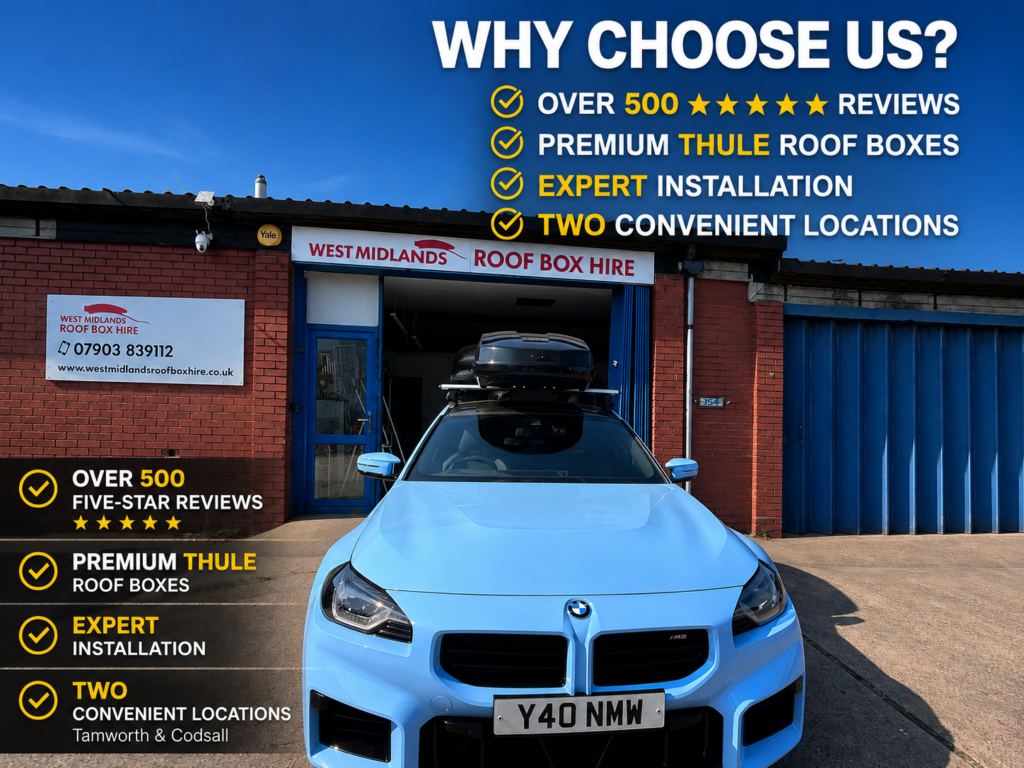
At West Midlands Roof Box Hire, we make one part of the holiday preparation easy.
We stock a large selection of roof bars and fitting equipment for different vehicles.
Provide us with your vehicle registration or exact vehicle details and we can check compatibility.
We then professionally fit the appropriate roof bars and roof box to your car.
When the holiday is finished, bring the vehicle back and we’ll remove them again.
No buying equipment.
No storing it afterwards.
And no trying to work out how to fit everything yourself.
Roof Box Hire in Tamworth and the West Midlands
Our main West Midlands Roof Box Hire premises are located in Tamworth, making us convenient for customers from Birmingham, Sutton Coldfield, Lichfield, Staffordshire and surrounding areas.
We also have a sister location in the Codsall/Wolverhampton area.
Together, our two locations allow us to provide roof box hire to families throughout a large part of the West Midlands and beyond.
Your Final October Half-Term Packing Checklist
Before you close the boot and set off, check that you’ve covered the essentials:
- Clothing appropriate for the forecast
- Waterproof clothing
- Suitable footwear
- Children’s belongings
- Toiletries
- Medication
- Chargers
- Travel documents
- Accommodation details
- Food and drinks for the journey
- Entertainment for children
- Breakdown information
- Anything required for planned activities
Then ask one final question:
Can everybody actually sit comfortably in the car?
If luggage is occupying the passenger space, it might be time to consider some additional storage.
Book Roof Box Hire for October Half-Term
If your October half-term packing pile is starting to look considerably larger than your car boot, West Midlands Roof Box Hire can help.
We provide large quality roof boxes, compatible roof bars and professional fitting.
Our Tamworth location is:
West Midlands Roof Box Hire Ltd
Unit 154, Amington Industrial Estate
Sandy Way
Tamworth
B77 4ED
To check availability and vehicle compatibility: View current hire prices or check availability online.
Telephone: 07903 839112
Email: westmidlandsroofboxhire@gmail.com
A little planning before you leave can make the entire journey easier.
Pack sensibly, leave yourself some space and enjoy your October half-term break.