
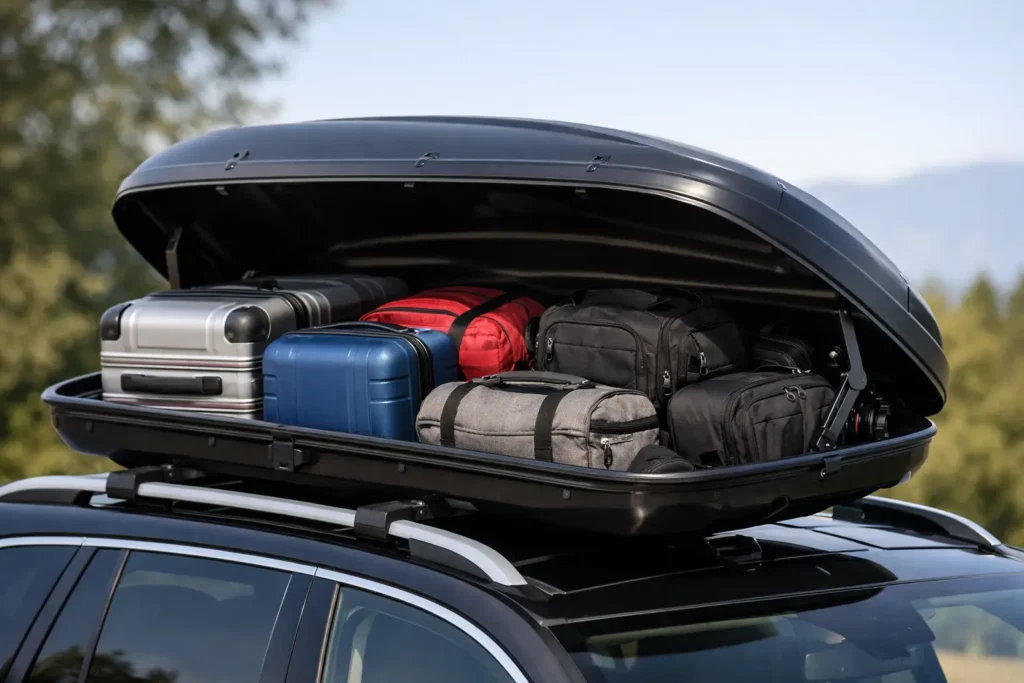
You usually notice the problem the night before a trip. The trunk is full, the back seat is filling up, and someone is asking where the stroller, coats, or camping bags are supposed to go. If you’re wondering how much luggage fits in a roof box, the honest answer is: more than most people expect, but not as much as people guess when they only look at the outside.
A roof box gives you useful extra space, not unlimited space. That distinction matters. The right box can take the pressure off family travel, free up legroom, and make long drives far more comfortable. But capacity depends on the box size, the shape of your luggage, your vehicle’s roof load limit, and how well the box is packed.
How much luggage fits in a roof box depends on more than liters
Most roof boxes are measured in liters, often somewhere between 300 and 500 liters for typical family use. That sounds simple enough, but liters only tell part of the story. A 400-liter roof box may hold several soft duffel bags with ease, while the same box feels tight if you try to load it with large hard-shell suitcases.
Shape matters just as much as volume. Roof boxes are long and relatively shallow. They are excellent for lighter, awkward items that take up space inside the car, but they are not always ideal for bulky rigid luggage. Think of them as extra storage for flexible travel gear rather than a rooftop replacement for your entire trunk.
As a practical guide, a medium roof box often fits luggage for two adults and one or two children if you pack sensibly. A larger box can often handle several soft bags, kids’ gear, coats, and extras like sleeping bags or folding travel items. What it usually will not do is swallow four large airport-style suitcases without a fight.
What actually packs well in a roof box
The best items for a roof box are soft, compressible, and lightweight. Duffel bags, backpacks, coats, bedding, sleeping bags, and children’s travel gear tend to fit very well. These items mold to the shape of the box, which means you waste less space.
Hard-shell cases are the opposite. They look neat, but they create gaps. Even if the total volume seems right on paper, the box may not close cleanly because the height or corners work against you. This is one of the most common surprises for first-time users.
Family travel usually works best when heavier luggage stays in the vehicle and lighter bulky items go on the roof. For example, shoes, jackets, diapers, beach towels, and travel bedding can move into the roof box, while denser items stay lower in the car. That balance is better for safety and usually makes packing much easier.
A simple way to estimate how much fits
If you want a realistic answer before booking or loading, picture the roof box in terms of bag types rather than raw measurements. A typical family-size box may take three to five soft travel bags, depending on their size, plus a few loose items packed around them. That can be enough to transform a crowded car.
For a weekend break, a roof box may comfortably hold most of the clothing and non-valuable soft items for a family. For a longer vacation, it often handles the overflow that would otherwise end up crammed at passengers’ feet.
If you’re traveling with a baby, dog, or camping gear, the value of a roof box becomes even clearer. Those trips create lots of bulky but fairly light items. A travel crib, blankets, changing bags, coats, and outdoor gear can quickly overwhelm the car’s interior even when the actual weight is manageable.
Roof box size matters, but so does your car
It is tempting to focus only on getting the biggest roof box possible. Bigger is not always better. Your vehicle has a roof load limit, and that includes the weight of the roof bars, the box itself, and everything packed inside.
That means a large box might offer plenty of volume but still need careful loading to stay within your car’s safe limit. This is why professional fitting and clear advice matter, especially for first-time users. You want enough room to solve the luggage problem without creating a handling or safety issue.
Smaller cars also suit different roof box sizes than SUVs or wagons. A box should fit the vehicle properly, allow the trunk to open if possible, and sit securely on the bars. Done properly, it feels like a practical extension of the car. Done badly, it becomes an inconvenience before you’ve even left the driveway.
How much luggage fits in a roof box for a family trip?
For most family trips, a roof box is less about fitting every bag you own and more about reclaiming space inside the vehicle. If a family of four is heading away for a week, a roof box can often take the softer luggage and bulky extras that make the cabin feel cramped.
That might mean the adults’ duffel bags, the kids’ coats, travel pillows, and a few day bags go on the roof, leaving the trunk free for heavier suitcases, food, or items you need to access more easily. On a camping trip, it may hold sleeping bags, mats, and lightweight equipment while denser items remain in the vehicle.
This is why there is no single universal answer. Two families going on the same length trip can need very different amounts of space. One packs neatly into soft bags. Another brings four rigid suitcases, sports gear, and a stroller. The box may be the same, but the result will not be.
Packing smarter makes a big difference
The way you pack can change how much luggage fits in a roof box by a surprising amount. Soft holdalls almost always outperform hard suitcases. Rolling clothing into flexible bags helps. Filling corners with coats or smaller items makes use of awkward spaces.
It also helps to pack by priority. Start with the larger light items, then fill gaps with compressible gear. Keep frequently needed items in the car rather than buried overhead. And avoid stuffing the box so tightly that it strains to close. If the lid needs to be forced, the load needs reworking.
Good packing is not just about fitting more in. It is about keeping the load secure and balanced. Weight should be spread evenly, with heavier items placed carefully and within the manufacturer’s guidance. A badly packed roof box can shift, affect handling, and make the journey less comfortable.
Common mistakes people make
The biggest mistake is assuming volume equals suitcase count. It does not. A box can look large from the outside and still be awkward for oversized rigid luggage.
The next mistake is ignoring weight limits. People often focus on whether an item physically fits, not whether it should be carried on the roof. That is where expert fitting and straightforward advice save a lot of trouble.
Another common issue is using the roof box as a place for valuables or fragile items. In most cases, that is not ideal. A roof box is best for general travel gear, not anything delicate, heavy, or essential during a quick stop.
So, is a roof box enough for your trip?
For many drivers, yes. A roof box is often the difference between an uncomfortable, overpacked car and a relaxed trip with proper passenger space. It is especially useful for vacations, family visits, weekends away, and camping trips where the challenge is bulk rather than pure weight.
If your current setup means bags are stacked around children, pets, or passengers, a roof box usually solves a very real problem. It gives everyone more room and makes the car feel organized again. For occasional travel, renting is often the sensible option because you get the extra space when you need it without paying to buy, store, and maintain equipment the rest of the year.
At West Midlands Roof Box Hire, that practical side matters. People do not want guesswork before a trip. They want clear pricing, proper fitting, and a straightforward answer on what is likely to fit.
If you are unsure, the best approach is to think in terms of the actual bags and gear you travel with, not just a liter number on a spec sheet. A well-matched roof box can carry a lot of luggage, but the real win is simpler travel, more comfort inside the car, and one less packing headache before you set off.