


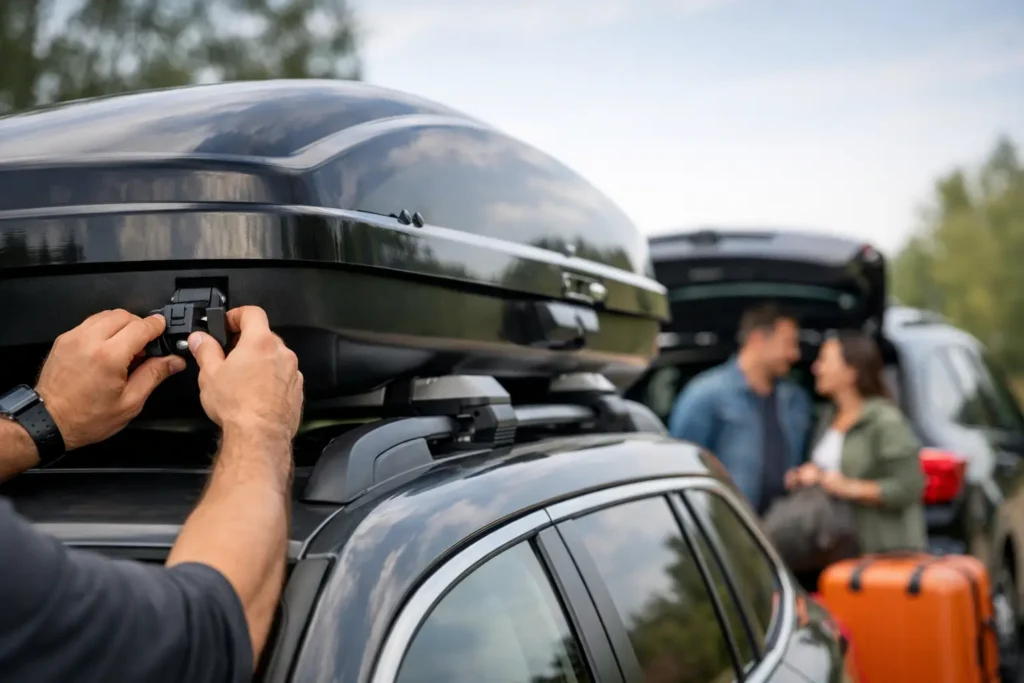
You usually notice roof box safety when something feels off – a whistle at highway speed, a hatch that will not open cleanly, or a car that suddenly feels taller and heavier than you expected. That is exactly why rental roof box safety tips matter before you set off, not halfway through a family trip when the car is already packed and everyone wants to get moving.
A roof box is a simple way to create space, but it changes how your vehicle carries weight, handles in crosswinds, and fits into everyday places like parking garages, drive-thrus, and hotel lots. If this is your first time renting one, the good news is that safe use is not complicated. It just comes down to fitting, loading, checking, and driving with a bit more care than usual.
Rental roof box safety tips start before you drive
The safest roof box trip starts before a single bag goes inside. The first thing to get right is compatibility. Not every roof box suits every car, and not every set of roof bars is appropriate for every roofline. A proper fit matters because even a high-quality box can become noisy, awkward, or unstable if it is mounted incorrectly.
This is where professional fitting makes a real difference, especially for first-time renters. A trained installer can make sure the bars are positioned correctly, the clamps are secured at the right points, and the box opens on the safest side for loading. It also removes the guesswork around torque, spacing, and clearance. For most drivers, that peace of mind is worth more than trying to save a few minutes in the driveway.
Before leaving, ask one practical question you will be glad you asked later: what is the total height of the vehicle once the box is fitted? Many people focus on weight and forget height until they meet a low barrier. Write the height down and keep it somewhere easy to see, because memory is not always reliable at the end of a long travel day.
Know the weight limits before packing
One of the most common mistakes is assuming the roof box can take whatever does not fit in the trunk. It cannot. Every setup has limits, and those limits come from more than one place. The roof box has a maximum load rating, the roof bars have their own rating, and your vehicle roof has a maximum dynamic load as well. The safe limit is always the lowest of those three numbers.
That matters because the box itself also weighs something. If your car roof is rated for 165 pounds and the box plus bars already account for a good portion of that, your luggage allowance may be lower than you expected. This is why lighter, bulky items are usually the best fit for a roof box. Think bedding, coats, soft bags, camping gear, or kids’ travel items. Heavy suitcases, tool bags, and dense equipment are often better kept inside the vehicle, as low down as possible.
Weight placement matters too. Try to spread the load evenly and keep the heaviest items centered rather than all at one end. If too much weight sits at the rear of the box, it can affect how the lid closes and how the car feels on the road. If it all sits to one side, the vehicle may feel uneven in corners or strong wind.
Pack for stability, not just space
It is tempting to treat a roof box like an attic on wheels and keep squeezing items in until the lid finally shuts. That is not safe, and it often leads to the exact problems drivers want to avoid – movement, rattling, difficulty locking the box, or strain on the hinges and latches.
A better approach is to pack with stability in mind. Soft-sided bags usually work better than hard-shell luggage because they fit the shape of the box more easily and create fewer pressure points. Keep loose items contained, fill gaps so gear cannot slide around, and avoid packing anything that could shift suddenly under braking.
If the box has internal straps, use them. They are there for a reason. Even a properly loaded box can experience movement when you brake hard or change lanes quickly. Securing the contents helps keep the load balanced throughout the trip rather than only when you first set off.
Make sure the lid closes without force. If you have to press down hard on one side, unpack and rearrange. The lock should engage cleanly. If it does not, the issue is usually packing, not the lock itself.
Check the box after the first few miles
Even with professional fitting, it is good practice to stop early in the trip and do a quick check. After the first 15 to 30 miles, pull over somewhere safe and inspect the roof box and bars. You are not looking for anything complicated. Just make sure the fixings still feel secure, the lid is fully closed, and nothing has shifted.
This quick stop is especially useful if you have joined a fast road soon after pickup or if the weather is windy. Small settling can happen early on, and a two-minute check is far better than wondering about a new noise for the next hundred miles.
After that, check again at fuel stops or rest breaks, particularly on longer trips. It is a simple habit, but it builds confidence and helps catch small issues before they become inconvenient.
Driving with a roof box takes a lighter touch
A car with a roof box is still easy to drive, but it will not feel exactly the same. The extra height increases wind resistance, and the extra weight up top changes the center of gravity. In everyday terms, that means the car may feel less settled in strong side winds, a little slower to stop, and less happy with sudden steering inputs.
So the smart move is to drive more smoothly. Leave a bit more braking distance. Take corners more gently. Avoid abrupt lane changes unless you really need them. If conditions are wet or windy, back off your speed and give yourself more room. There is no prize for driving as if the car were empty.
Highways deserve special attention because this is where wind noise, drag, and crosswind effects show up most clearly. If the box is loaded and fitted correctly, some noise is normal. What you do not want is a new clunking sound, a repeated vibration, or anything that suggests movement. If in doubt, stop and inspect.
Watch for clearance everywhere, not just parking garages
Most people remember bridges and parking decks. Fewer remember hotel entrances, fast-food canopies, ferry access points, car wash signs, and tree branches over vacation rentals. Height-related mistakes often happen at low speed, when drivers are relaxed and no longer thinking about the roof.
That is why one of the best rental roof box safety tips is also one of the simplest: keep your total vehicle height visible. A note on the dashboard or in your phone can save a lot of stress.
If a clearance bar looks close, do not guess. Stop, check, and choose the safer option. The few minutes you lose are nothing compared with damaging the box, the car, or your trip plans.
Keep access sensible during the trip
A roof box is useful, but it should not become your main grab-everything storage area once you are on the road. The more often you open it, the more chances there are to repack poorly, misplace keys, or rush the closure.
Try to store the items you will need during travel inside the vehicle instead. Snacks, medications, rain jackets, pet supplies, and overnight essentials are better kept where you can reach them easily. Use the roof box for items you will not need until arrival.
This also helps with safety at roadside stops. Opening a roof box next to traffic, in bad weather, or on uneven ground is never ideal. Planning ahead reduces that need.
Weather changes the equation
A roof box can handle normal travel conditions well, but weather still matters. Heavy rain, strong gusts, and winter roads all make smooth, cautious driving more important. In gusty weather, you may notice the vehicle reacting more than usual when passing large trucks or driving across exposed stretches of road.
That does not automatically mean there is a problem. Often it simply means you need to slow down and hold a steadier line. If the weather becomes severe, stopping for a break is the sensible choice.
Rain also makes loading and unloading more awkward, which is another reason not to overfill the box. A lid that is easy to open and close in dry conditions can become frustrating in wind and rain if everything is packed too tightly.
Safe return starts with unloading properly
At the end of the trip, do not rush the final step. Remove your gear carefully, check that nothing small has slid into the corners, and avoid forcing the lid or leaving damp items inside. If the box has picked up dirt, bugs, or road spray, a basic wipe-down helps keep everything in good condition.
If you rented from a specialist service such as West Midlands Roof Box Hire, returning the equipment in a reasonable, well-cared-for state is part of keeping the whole experience straightforward for everyone. It also makes your next booking easier, because you already know the routine.
The best roof box setup is the one you stop thinking about once the trip begins. When it is fitted properly, packed sensibly, and driven with a bit of extra care, it simply gives you the space you needed without adding stress. That is really the goal – more room for the trip, and less to worry about on the way.