


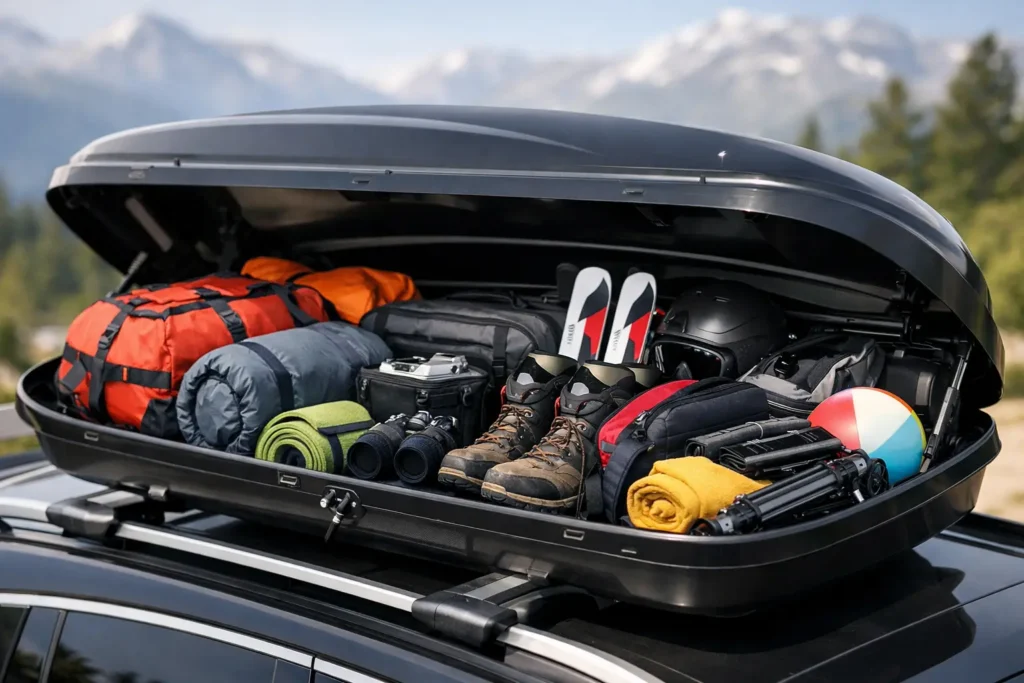
The moment the trunk won’t close and the back seat starts filling up with coats, snack bags, and kids’ gear, the same question comes up fast: what fits inside a roof box? For most trips, quite a lot more than people expect. A roof box is ideal for the bulky, awkward, soft-sided items that take over your car, but it does have limits, and knowing those limits makes the trip easier from the start.
If you’ve never used one before, the simplest way to think about a roof box is this: it gives you extra space, not unlimited space. It works best when you use it to move lighter luggage, outdoor gear, and travel items out of the cabin so everyone inside the car has a bit more breathing room.
What fits inside a roof box for most trips
For a family vacation, a roof box will usually take several duffel bags, soft suitcases, coats, sleeping bags, pillows, and strollers that fold down neatly. It’s also useful for camping gear like tents, ground mats, and folding chairs, depending on the size and shape of the box.
That shape matters more than people think. Roof boxes are long and fairly narrow, so they suit items that are lightweight and easy to stack. A few medium duffel bags often fit better than one large hard-shell suitcase. Soft luggage is easier to position around the curves of the box, which helps you make the most of the space.
For couples heading away for a weekend, a roof box can often carry most or all of the luggage, leaving the trunk free for everyday items, a cooler, or pet supplies. For larger families, it usually acts as overflow storage rather than replacing the trunk altogether. That’s often the difference between a cramped drive and a much more comfortable one.
The best items to pack in a roof box
The best roof box loads are practical, fairly light, and not fragile. Clothes, bedding, towels, ski wear, wetsuits, and camping textiles are all good examples. These are the items that take up plenty of room inside the car without being especially heavy.
Kids’ gear often works well too. Travel cots that fold down compactly, changing bags, extra blankets, and soft toy bags can usually go overhead and free up valuable cabin space. If you’re traveling with a dog, a roof box can make room in the car for a crate or dog guard setup by moving the human luggage out of the way.
Outdoor trips are where roof boxes really earn their keep. Walking boots, waterproofs, rolled-up tents, sleeping bags, and spare layers all tend to be awkward to pack in a standard trunk. Put them in a roof box and the whole vehicle feels more organized.
What usually does not fit inside a roof box
Hard, square, heavy items are where things get trickier. A large hard-shell suitcase may fit in some boxes, but not in others, and even if it does, it might waste space that could be better used by several smaller bags. Very bulky strollers, rigid coolers, and boxy travel equipment can also be difficult because of the tapered shape of many roof boxes.
Weight is just as important as physical size. Even if an item can fit inside, that doesn’t always mean it should go there. Roof boxes and roof bar systems have load limits, and your vehicle does too. Overloading the roof affects handling, braking, and stability, especially at highway speeds or in crosswinds.
You also want to avoid valuables, fragile electronics, and anything that could be damaged by heat, cold, or movement in transit. A roof box is secure when fitted properly and locked, but it’s still better to keep passports, laptops, cameras, and anything essential inside the car with you.
Size depends on the roof box itself
Not every roof box holds the same amount. Some are designed for general vacation luggage, while others are longer and better suited to skis or narrower outdoor gear. Capacity is usually measured in liters, but that number only tells part of the story.
What really matters is the combination of length, width, height, and weight allowance. A box with generous liter capacity may still struggle with certain shapes, while a slightly smaller one may pack more efficiently with the right luggage. That’s why first-time users often benefit from a bit of guidance before they load up.
In practical terms, many standard roof boxes are well suited to two to five soft bags plus smaller loose items. Larger models can take more, but the smartest approach is still to pack by shape and weight rather than just trying to fill every inch.
How to judge what fits inside a roof box before you travel
A good rule is to lay out what you plan to take and separate it into three groups: soft luggage, bulky light items, and heavy essentials. The soft luggage and bulky light items are usually the best roof box candidates. Heavy essentials are better kept low down in the car.
If you’re deciding between putting something in the trunk or on the roof, ask two questions. Is it light enough to go overhead safely, and is it awkward enough that moving it out of the car will make the journey more comfortable? If the answer to both is yes, it probably belongs in the roof box.
It also helps to think about what you’ll need during the drive. Rain jackets, picnic supplies, and overnight bags for a stop along the way are often better kept somewhere easy to reach. A roof box is best for items you don’t need every hour.
Packing a roof box properly matters as much as capacity
Even when you know what fits inside a roof box, poor packing can cause problems. Heavier items should go in the middle of the box where possible, with lighter items around them. That keeps the load balanced and reduces movement while driving.
You don’t want loose gear shifting around every time you brake or turn. Pack snugly, but not so tightly that the lid has to be forced shut. If the box won’t close cleanly, it’s a sign you need to repack rather than push harder.
Try to keep the left and right sides balanced too. An uneven load can affect how the car feels on the road. It may seem minor in the driveway, but you’ll notice it more on longer drives, especially if the weather turns.
Common packing mistakes
The biggest mistake is assuming a roof box should take the heaviest gear because it looks sturdy. In reality, the safest use is often lighter, bulkier travel equipment. Another common mistake is loading one giant suitcase and then realizing there’s no practical way to fit anything around it.
People also forget that overall vehicle height changes with a roof box fitted. That matters at parking garages, drive-thrus, and some hotel entrances. It’s a small detail until you’re tired, the car is full, and you’re trying to pull into a low clearance space.
Last, there’s the habit of throwing in last-minute items without checking the total load. A few extra bits here and there add up quickly. Staying within the recommended limit is part of safe travel, not just a technicality.
So, what fits inside a roof box for your kind of trip?
If you’re heading to the beach, think towels, beach toys, spare clothes, and lighter family bags. For a camping trip, think tent fabric, sleeping bags, mats, and outer layers. For a winter break, think jackets, ski clothes, gloves, and soft luggage. For a family road trip, think everything that steals passenger legroom but doesn’t need to sit low in the car.
That’s usually the sweet spot. A roof box is there to take the pressure off your vehicle, not to become a storage challenge of its own. Used properly, it makes packing simpler, keeps the cabin more comfortable, and gives you a better start to the trip.
For first-time users, that reassurance matters. Professional fitting and clear advice make a real difference because the right box, loaded properly, feels straightforward from the moment you set off. West Midlands Roof Box Hire helps take that guesswork out of the process, which is exactly what most families want before a trip.
If you’re not sure whether your bags, stroller, or vacation gear will fit, the safest answer is not to guess. Think in terms of light, bulky, and soft-sided first, and you’ll usually be much closer to a roof box load that works well.